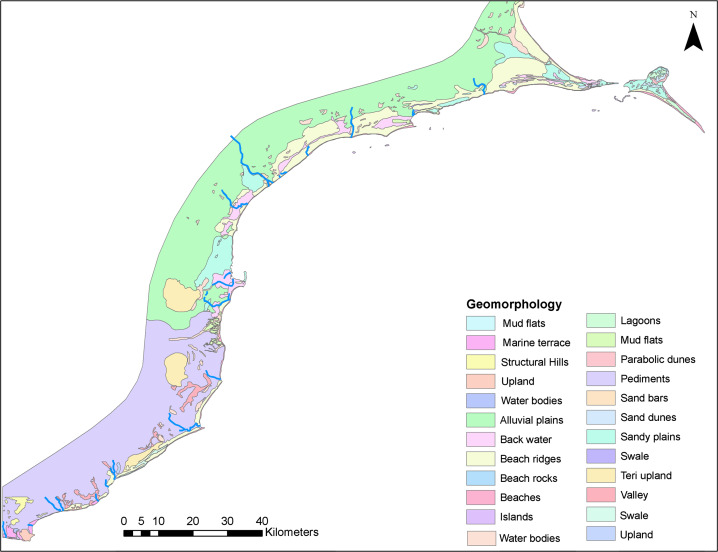
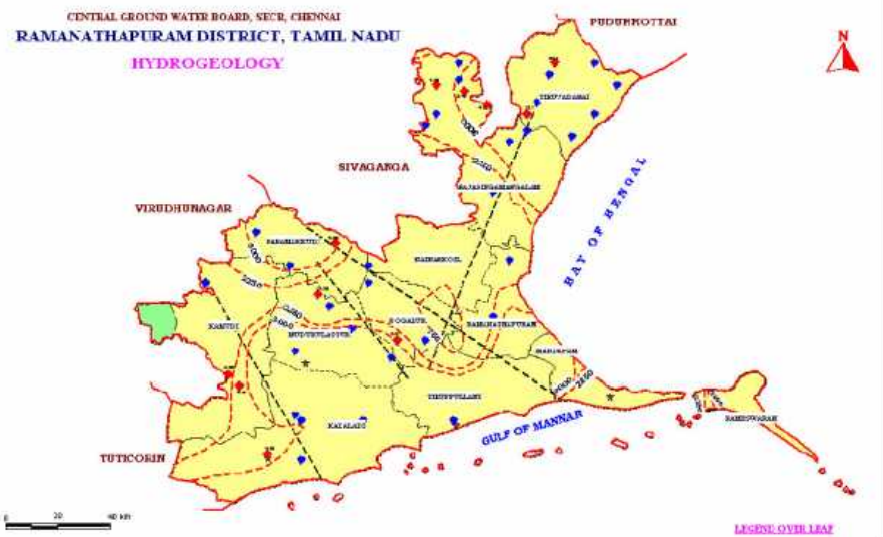
Geology of Ramanathapuram District
Ramanathapuram’s geology is primarily characterized by young, unconsolidated sediments of Quaternary age. Small, isolated areas in the northwest contain older Archaean crystalline rocks and Tertiary sandstones.
Archaean Crystallines and Tertiary Sandstone:
In the northwest, isolated patches of Archaean crystalline rocks (Charnockite and Khondalite Groups – garnetiferous granulite, quartzite, gneisses) and Tertiary sandstone (Cuddalore Formation – variegated sandstone and claystone, with thin alluvium cover) are found.
Laterite and Soils:
Detached exposures of laterite and lateritic soils also occur in the northwestern part of the district.
Sedimentary Deposits and Formations
A large part of Ramanathapuram is covered by Quaternary sediments, including fluvial, fluvio-marine, aeolian, and marine deposits.
Fluvial Deposits:
Along the Vaigai, Gundar, Manimuthar, and Pambar rivers, you’ll find fluvial deposits (sand, silt, clay), categorized as levee, flood basin, channel bar/point bar, and paleo-channel deposits. Paleo-channels contain brown, fine to medium sands with cross-bedding.
Fluvio-Marine Deposits:
The Vaigai delta features fluvio-marine deposits: deltaic plain and dune flats (medium, grey-brown sands), and paleo-tidal flats (black silty clay, black clay, mud). Rameswaram Island also has fluvio-marine deposits of indurated and dune sands.
Aeolian Deposits:
Aeolian deposits (red sands from ancient dunes) stretch 3.2 km wide and 8 km long, parallel to the coast, separated by marshy black clays and underlain by calcareous hardpan. Brown sand deposits are also found in Rameswaram Island near Sambaimadam.
Influence of the Gulf of Mannar:
The Gulf of Mannar Biosphere Reserve significantly influences the local geology. This includes:
Coral Reefs:
These biologically diverse structures are built by coral polyps and create unique marine habitats. They also contribute to the formation of calcareous sediments.
Island Formation:
The islands in the Gulf of Mannar are often formed by a combination of coral growth, sand accumulation, and tectonic activity.
Limited Exposure of Crystalline Basement:
The older crystalline basement rocks (charnockites, gneisses) that are common in many parts of Tamil Nadu are not extensively exposed at the surface in Ramanathapuram. They likely underlie the younger sediments but are only visible in a few isolated locations or through subsurface data.